
Exam Analytics for Schools Turn Every Test Into Higher Student Performance.
Stop wasting exam data. Discover how topic-wise trends, alerts, and dashboards help teachers intervene early and improve student outcomes with MyQampus.
The “200+ Exams” Problem Nobody Talks About
Your school runs unit tests, midterms, finals, mocks, internal assessments—often 200+ exams a year.
Each one generates data. And most schools do the same thing after every exam:
Grade → record marks → return papers → move on.
That’s not assessment. That’s a data graveyard.
And the cost isn’t just “messy reporting.” The real cost is that students repeat the same mistakes because nobody saw the pattern early enough.
The Exam Data Graveyard (4 Scenes You’ll Recognize):
1) The repeated mistake;
In September, Grade 10 struggles with Trigonometry. In November, the same students fail it again.
Not because they’re careless—because the system never highlighted: “60% missed the same topic.”
2) The invisible decline:
Priya’s Math scores slide from 78% → 65% → 52%.
Nobody notices until finals, when she crashes to 45%.
Parents ask: “Why didn’t anyone tell us earlier?”
3) The hidden strength:
One section consistently scores higher because one teacher’s method works better.
But the school never sees it, so excellence doesn’t scale.
4) The wrong focus:
Teachers spend time on what they enjoy (or feel confident teaching), not what students need most—because there’s no clear signal showing where learning is breaking.
What Exam Analytics Should Do (Not Just “Show Marks”)
A modern Grades & Exam Manager should do more than store scores. It should convert exam results into decisions:
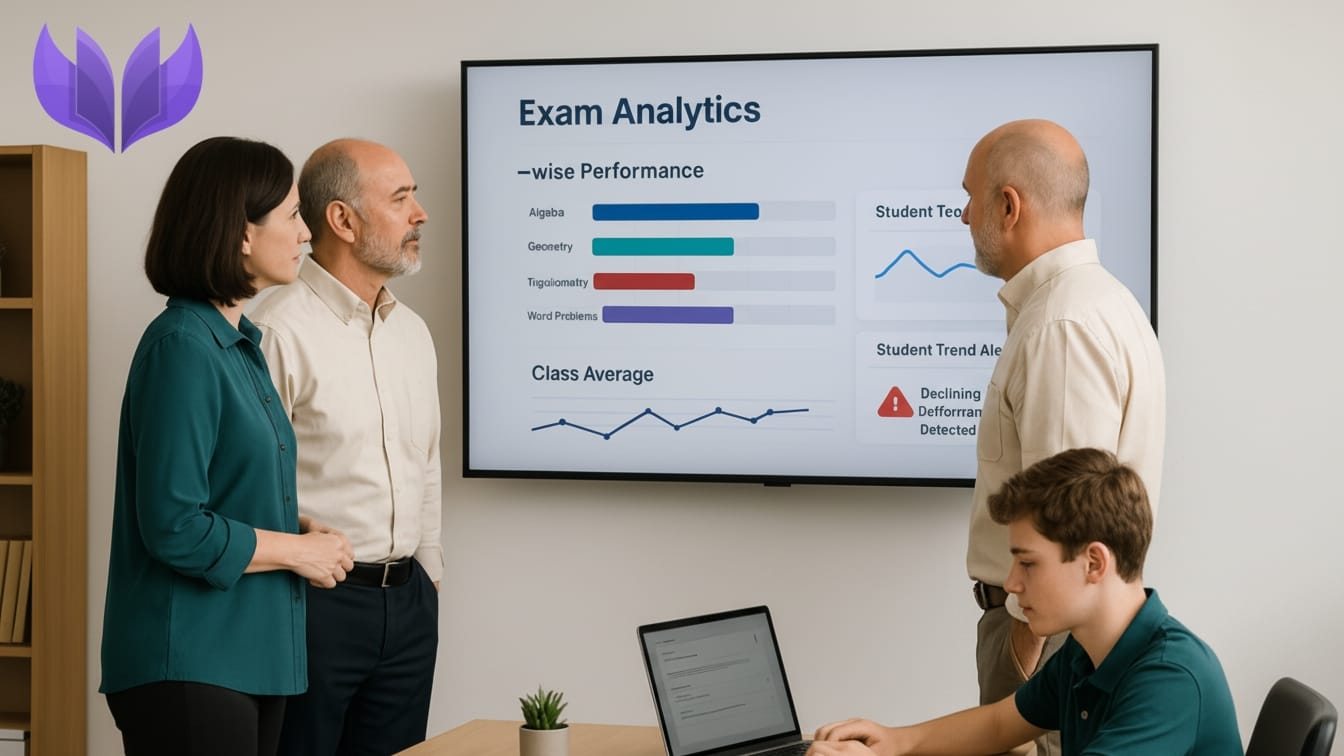
1) Topic-wise performance (real diagnosis);
Instead of: “Ramesh got 65/100.”
You see: Algebra strong, Trigonometry weak, Word Problems weak.
Now the intervention is targeted, not generic.
2) Class-wide topic gaps (teach what the class needs):
You instantly spot: “Trigonometry average = 45%.”
That’s not a student problem—that’s a teaching + revision priority.
3) Student trend alerts (catch the fall early):
If a student drops across 2–3 assessments, the system flags it.
So teachers intervene while there’s still time to fix it.
4) Comparative section insights (find what’s working):
Section B is outperforming Section C. Why? Different teacher? Different method? Different support needs?
Analytics turns a mystery into a plan.
5) Question-level insights (fix teaching + exam quality):
If 85% missed Question 12, it’s either a teaching gap—or a badly framed question. Either way, you improve.
Where MyQampus Fits:
MyQampus is designed as a school management platform that centralizes operations and academics .Its Exam Manager supports core exam operations like creating/publishing exam schedules/date sheets, assigning exam halls/invigilators, and managing student marks and the natural next step is turning those marks into actionable analytics teachers and coordinators can use.
The “Feedback Loop” That Improves Results,
Without analytics: Teach → Test → Record → Move on
With analytics: Teach → Test → Analyze → Intervene → Retest → Improve
That’s how schools move from exam-driven pressure to learning-driven progress.
Want to stop repeating the same mistakes every term?
Add analytics to your exam process so teachers can intervene early, coordinators can spot gaps, and parents get clarity.
Explore MyQampus: https://myqampus.com/features
FAQs
1 What is exam analytics in schools?
It’s using assessment data to identify topic gaps, trends, and intervention opportunities—not just publishing scores.
2 How does topic-wise analysis help students?
It pinpoints exactly what a student is struggling with, so practice and reteaching are focused.
3 Is exam analytics only for large schools?
No—smaller schools benefit even more because early intervention is easier to coordinate.
4 Do teachers need extra time for analytics?
Good dashboards reduce time: they summarize insights automatically instead of manual spreadsheets.
5 How do parents benefit from exam analytics?
They get specific strengths/weaknesses and clear recommendations, not vague “can do better.”