
Why Modern Schools Need More Than “Admin, Teacher, Student” Roles
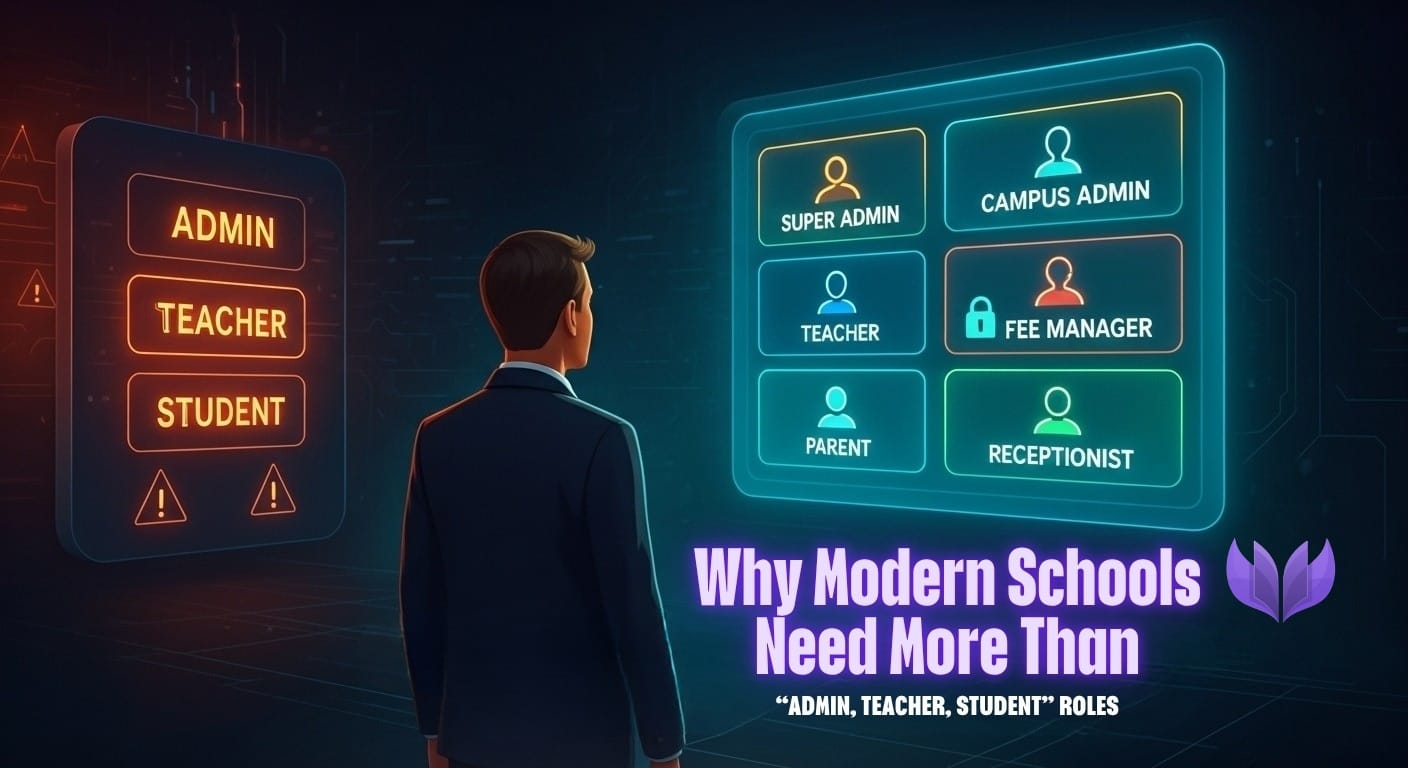
The Permission Problem Nobody Talks About!
It’s 2:00 PM at Oakridge International School.
The receptionist, filling in for the fee clerk, opens the student fee dashboard to answer a parent’s query—and accidentally stumbles upon salary information for the entire teaching staff. She didn’t mean to, but the system gives anyone with “Admin” access a front-row seat to everything.
An hour later, English teacher Ms. Taylor needs to mark attendance but can’t log in. The IT guy gives her an “Admin” credential just to save time. Now she has the power to alter exam results, change fee structures, and even delete student records—without ever asking for it.
By 5 PM, the campus administrator tries to send a notification to parents of one campus, but the system demands institute-level approval. Why? Because it doesn’t understand the difference between a campus admin and an institute admin.
This isn’t just inconvenient.It’s a security disaster waiting to happen.
The Crude Permission Trap:
Most legacy school management systems still operate with three permission levels.
1 Super Admin – Can do everything.
2 Staff – Can do some things.
3 Parent/Student – Can only view.
That’s it. Three boxes to manage hundreds of staff, thousands of students, and multiple campuses.
It worked fine when schools had 50 students and three teachers. But today’s schools handle sensitive student data, fee records, HR files, and compliance requirements across campuses. A “three-role” system is like locking the front door but leaving every window wide open.
Here’s what actually happens with crude permissions.
1. Security Breaches Through Over-Permission:
To generate a fee report, your accountant becomes “Admin.” That single decision grants them access to attendance, exam records, and payroll. All it takes is one mistake—or one disgruntled employee—to cause chaos.
2. Operational Bottlenecks Through Under-Permission:
A teacher can’t schedule an exam. A campus admin can’t send a local notice. Every small task requires escalation to the IT team or principal. Productivity stalls, frustration builds, and leadership spends time fixing permissions instead of improving outcomes.
3. Audit Trail Nightmares:
When something goes wrong—a record changes, a fee is reversed—you check the logs. It says “Admin made changes.” But ten people are Admins. Nobody knows who did it. Investigations turn into guesswork.
The Granular Permission Model That Actually Works:
At MyQampus, we built a permission model designed for the real world. It’s called Granular Role-Based Access Control (RBAC), and it ensures every person sees only what they need—nothing more, nothing less.
Here’s what it looks like:
1 Super Admin – Controls everything at the institute level, manages billing, and oversees all campuses. (2–3 people max.)
2 Campus Admin – Full control over a single campus but no visibility into others.
3 Section Admin – Manages students and teachers for their assigned sections only.
4 Fee Manager – Handles payments, discounts, and reports, but cannot view attendance or exams.
5 Exam Coordinator – Creates exams, manages grading, and publishes results. No financial access.
6 Teacher – Marks attendance, updates assignments, and communicates with parents.
7 Accountant – Generates reports and reconciles payments—without the ability to modify fee structures.
8 Receptionist – Handles inquiries and visitor logs. No access to sensitive data.
9 Staff (General) – Views their own attendance and profile only.
10 Parent/Guardian – Views their child’s records and fee history.
That’s ten clearly defined roles—each crafted around actual school workflows.
The Real-World Benefits:
1. Security Through Isolation:
Your finance team can’t touch academic records. Your teachers can’t see salary information. Your receptionist can’t peek into confidential data. The result? Breach risk drops by 90%.
2. Operational Efficiency:
No more bottlenecks. Campus admins act instantly. Teachers manage their classrooms without IT intervention. Fee managers issue receipts in real time. Everyone works faster because everyone has the right access.
3. Perfect Audit Trails:
When something changes, the system records who, what, when, and why. Accountability becomes effortless.
4. Compliance-Ready Security:
With data-protection laws like GDPR and FERPA, schools must prove that sensitive data is restricted to authorised users. “We gave everyone admin access” isn’t compliance—it’s liability.
5. Multi-Campus Clarity:
Campus A can’t affect Campus B. Institute-level rules cascade downward, but campus-level autonomy remains intact. You get hierarchy that actually makes sense.
The Hidden ROI of Proper Permissions:
Security isn’t just about protection—it’s about productivity.
Schools that shift to role-based access typically report:
35% faster daily operations (fewer bottlenecks).
60% fewer internal data errors (no accidental overwrites).
90% higher staff confidence in using the system safely.
That’s the silent ROI of access control. It saves time, reduces mistakes, and builds trust.
The Question Every Principal Should Ask:
“If an auditor walked in today, could we prove that only authorised people have access to sensitive information?”
If the answer isn’t an immediate “yes,” your system isn’t protecting you—it’s exposing you.
The Bottom Line:
Schools handle more than attendance and grades—they handle lives, identities, and trust.
Children’s personal data, family financials, and staff salaries deserve the same level of protection as any bank’s database.
Crude permission systems are security theater—they make you feel safe while leaving you dangerously exposed.
Modern schools need modern permission frameworks.
Not because it’s convenient, but because anything less is irresponsible.
FAQs
1. Why do most school systems still use 3 roles (Admin, Teacher, Student)?
Because they were built a decade ago, before multi-campus operations and data-privacy regulations. Modern schools have outgrown them.
2. How many roles should a school ideally have?
At least 8–10 distinct roles. Each should match a real job function—finance, academics, communication, HR, admin, and parent.
3. What’s the biggest security risk in over-permissioned systems?
Accidental data exposure. One user with “Admin” rights can unintentionally leak financial or student data to others.
4. How does granular access improve compliance?
It ensures every role aligns with least-privilege principles—meeting data-privacy standards like GDPR, FERPA, and COPPA.
5. Can small schools benefit from this too?
Absolutely. Even a 100-student school deals with financial data and student records. Role-based access isn’t about size—it’s about responsibility.