
Your Timetable Is the Operating System of Your School ROI, Data & Admissions Power
By now, we’ve seen:
Part 1: How chaotic timetables quietly destroy learning time.
Part 2: What digital timetables actually do.
Now let’s talk about what school owners and principals in the USA, Canada, Australia and New Zealand really care about:
a)Return on investment (ROI).
b)Operational efficiency.
c)Parent trust and admissions.
d)Data for better decisions.
Because a timetable is not just “a schedule”. It’s the operating system of your school.
1. Time Saved = Money Saved:
Manual timetable management;
- 2–3 hours every week fixing changes, conflicts and substitutes.
- 8–12 hours every month.
- Almost 100+ hours a year of coordinator/admin time.
Digital timetable management:
- Real-time updates.
- One place to adjust and notify.
- Often 30 minutes or less per week for changes.
That difference is not “nice to have”.
That is weeks of staff time freed for:
a)Academic planning.
b)Teacher support.
c)Parent communication.
In higher-salary markets like North America and Australia, that’s a direct financial ROI.
2. Reduced Wastage of Learning Time:
When timetable chaos drops, so do;
- Empty classes.
- “Free periods” that shouldn’t be free.
- Classes starting 10–15 minutes late due to confusion.
Across an entire year, a school can easily recover hundreds of teaching hours that were previously lost.
More teaching hours =
- Better coverage of syllabus.
- Less last-minute exam panic.
- Stronger academic outcomes that parents notice.
3. Better Teacher & Student Planning:
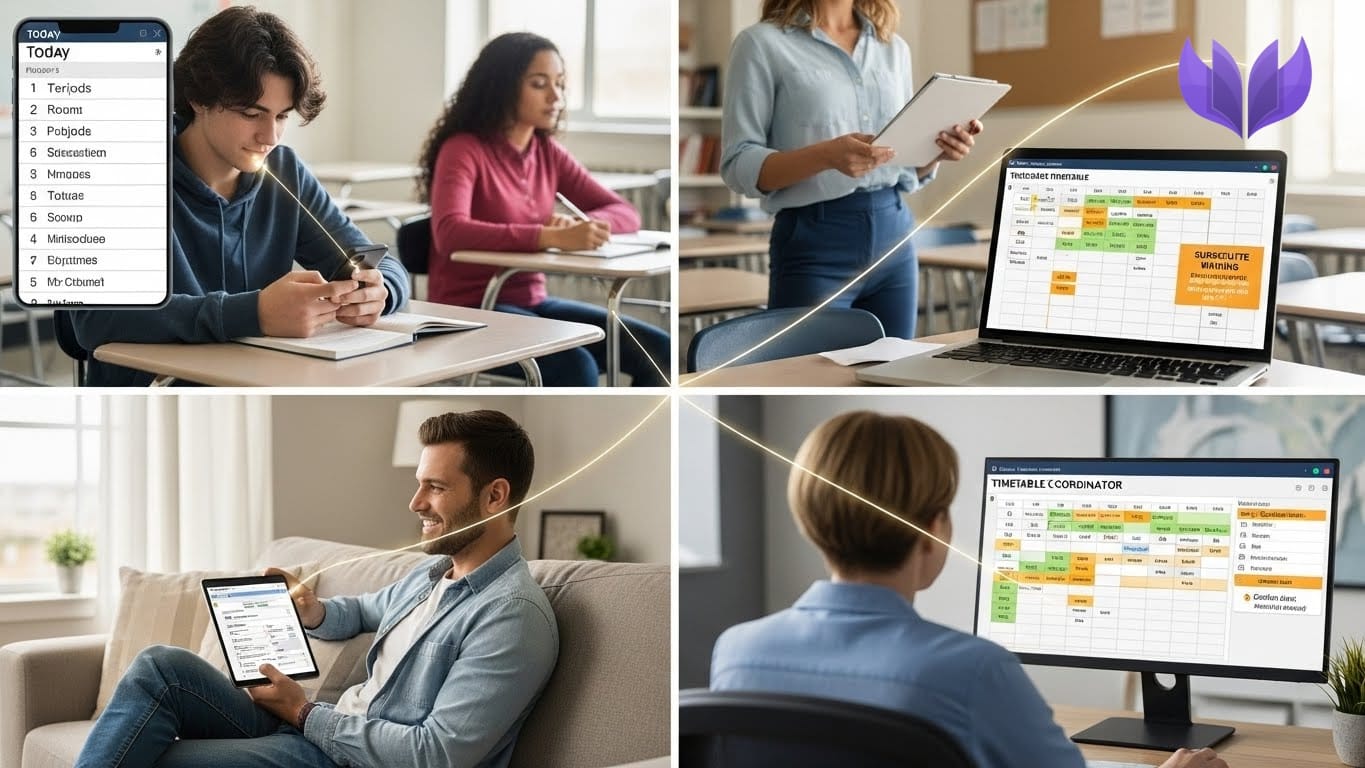
With a digital timetable, teachers in the US, Canada or Australia can;
- See their week at a glance.
- Align lesson plans with actual periods.
- Prepare labs and resources in advance.
- Coordinate with colleagues to avoid overload on students.
Students can:
- Check the next day’s schedule.
- Bring correct books.
- Plan homework around actual timetables.
This moves your school from reactive to proactive.
4. Emergency Communication Power:
Imagine;
A snowstorm warning in Canada.
- A heatwave in Australia.
- A sudden infrastructure issue in a US district.
Without a digital system:
- Admins run from class to class.
- Hope students inform parents.
- Some parents never get the message in time.
With a system like MyQampus:
- You send one central announcement.
- Parents, students and teachers instantly get notified in the app.
- Timetables adjust (e.g., early dismissal), and everyone sees it.
In emergencies, communication speed = safety + trust.
5. Admissions & Reputation Advantage:
Parents comparing two schools;
School A:
“We’ll give you a printed timetable at the start of the year. If anything changes, your child will be informed.”
School B (using MyQampus):
“You’ll have a parent app where you can see the live timetable, exams and special days. If anything changes, you and your child are informed instantly.”
Which sounds more:
a)Organised?
b)Transparent?
c)Worth the fees?
In competitive markets, a digital timetable is a visible proof that your school is modern, structured and serious about learning time.
6. Data, Analytics & Accountability:
After one year on a digital timetable, you can see patterns like;
- Which subjects face frequent disruptions.
- Which teachers take the most substitutes (and why).
- When labs, grounds and auditoriums are under-used or over-used.
- Where timetable design is causing stress or inefficiency.
This is gold for leadership:
- Design backup plans.
- Adjust staffing.
- Rework schedules based on real data.
It’s not about micromanaging people. It’s about seeing reality clearly, then improving it.
7. Why MyQampus Treats the Timetable as Core, Not Extra:
In MyQampus, the Timetable Manager isn’t a “side feature”. It’s central;
Integrated with attendance, communication and academics. Built for multi-campus schools in USA, Canada, Australia, New Zealand and beyond. Designed to support real-world school complexity, not just a pretty grid.
When your timetable becomes digital, live and connected, everything else in your school starts to run smoother.
The Real Question:
The real question for any modern school isn’t;
“Should we go for digital timetables?”
It’s:
“How much learning, time and trust are we losing every week because we’re not?”
If the honest answer is “more than zero”, it’s time to change.
Want to see this in action?
Explore how MyQampus Timetable Manager can turn your timetable into the true operating system of your school:
- Book a live demo.
- Or test a guided walkthrough of the teacher and coordinator views.
FAQs (Part 3)
1. How can we calculate the ROI of a digital timetable for our school?
List all hours spent on timetable changes + fixes + substitute management today. Multiply by staff hourly cost. Then compare to the reduced hours with a digital system. Add the value of recovered teaching time and improved parent satisfaction.
2. Will a digital timetable replace our coordinators?
No. It amplifies them. Instead of doing manual firefighting, they spend more time on planning, academic quality and teacher support.
3. What if our internet goes down?
Timetables are usually cached on devices. Once the connection returns, information syncs. And typically, strong cloud infrastructure is more reliable than one local Excel file.
4. Is this suitable for public/government schools, or only private schools?
Both. Public districts and private chains in USA, Canada and Australia are already using digital systems. The question is strategy, not sector.
5. Is switching mid-year a bad idea?
If timetable chaos is hurting you now, mid-year may actually be the best time to fix it. Many schools start with a few grades or one campus, then expand.